UW MHCID x Adobe
Designing an AI Assistant forSoccer Coaches
Timeline
Spring–Summer 2026
Role
Product Designer,
Project Manager
Team
Chandana Mekala
Madhurima Chatterjee
Madeleine Iribarren

Nivedha Shanmugam
Umi Chen
Adobe Industry Advisor
Project context
Collegiate soccer coaches make recruiting decisions across fragmented platforms, data, and communication channels. We designed an AI-assisted workspace spanning web, mobile, and watch to bring those workflows together, informed by research with Division I coaches and experts across collegiate and professional soccer.
Expert Contributors
Amphone Keovongmanysar · Columbia University
Nicole Van Dyke · University of Washington
Whitney Pitalo · University of Washington
Impact
- Led stakeholder outreach and research across 15 coach and expert interviews
- Owned product strategy for an AI assistant embedded in coaches’ existing workflows
- Defined the cross-platform framework across preparation, live scouting, and roster decisions
- Owned design and prototyping for the core AI-assisted workflow and key annotation interactions; led user feedback across all major flows
Smart Summaries
Relevant information and recommendations surface as coaches move through recruiting—adapting to what they’re doing in real time.
Problem
Coaches are making high-stakes decisions with fragmented information
Recruiting a collegiate soccer player isn’t a single workflow. Coaches move constantly between recruiting platforms, spreadsheets, email, text messages, video, calendars, and conversations with their staff, piecing together information about hundreds of prospective players.
The information they need exists, but rarely where or when they need it. Coaches rely heavily on memory and manual work to connect what they’ve seen, heard, and recorded across tools, adding friction to an already time-constrained decision-making process.
Research
We went directly to coaches to understand how decisions get made
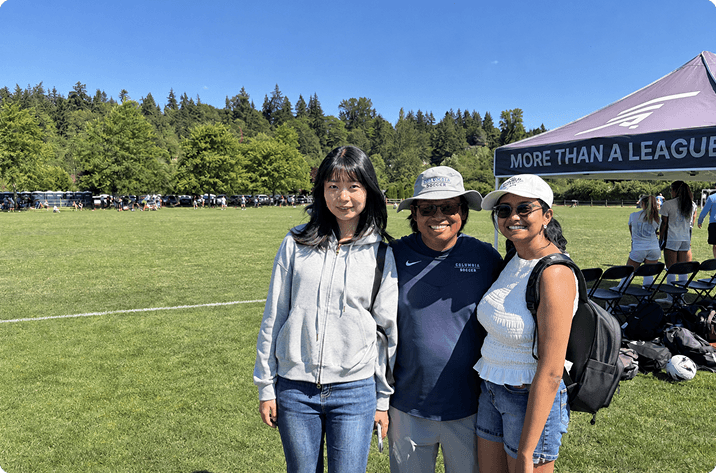
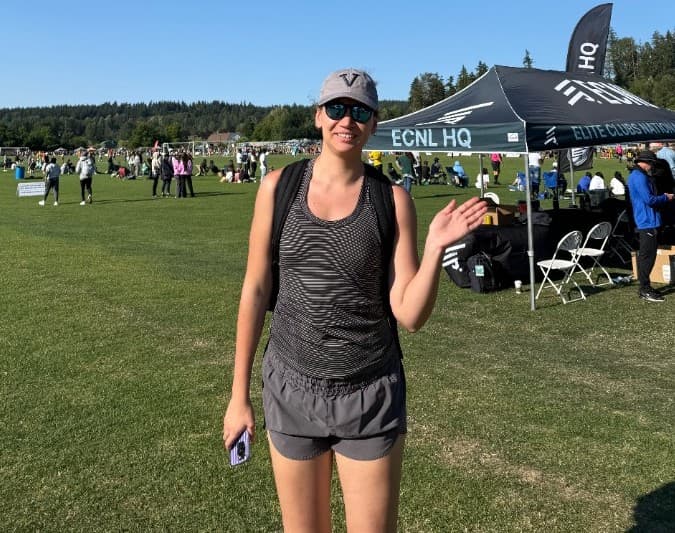
We interviewed 6 collegiate soccer coaches and followed 3 onto the field to observe recruiting firsthand. We also consulted 9 subject matter experts across collegiate and professional soccer to understand the broader recruiting and soccer ecosystem.
These insights pointed to an opportunity: help coaches turn fragmented information into shared, actionable judgment.
I led stakeholder outreach and research coordination, participated in all but one interview, initiated and conducted field research, and helped to drive synthesis from raw findings into product direction.
Recruiting is messy and fragmented.
Coaches gather and manage recruiting information across disconnected tools, leaving critical context scattered across their workflow.
Time is coaches’ biggest constraint.
Coaches are constantly balancing recruiting with the day-to-day work of running and developing their team.
Recruiting decisions are shared.
Staff make decisions together, but traditional lists and rankings can hide the tradeoffs they need to discuss.
Capture
Interviews & notes

Code
Dovetail
Cluster
FigJam affinity map
Synthesize
Key insights
Capture
Interviews & notes
Code
Dovetail
Cluster
FigJam affinity map
Synthesize
Key insights
Capture
Interviews & notes
Code
Dovetail
Cluster
FigJam affinity map
Synthesize
Key insights
Opportunity
Meet coaches where they are
Our research showed that coaches didn’t need yet another tool to manage. They already worked across a wide range of digital tools, but technical constraints and paid tiers often limited what those tools could do. Time was also their biggest constraint. They needed support that could work within the messy, fragmented reality of recruiting.
I pushed our team toward an AI assistant that could meet coaches across the tools and devices they already use, rather than asking them to adopt an entirely new workflow.
Solution
Introducing: Kit
Kit is a context-aware, agentic AI system designed around the realities of collegiate soccer recruiting.
It moves with coaches across desktop, mobile, and smart watches, helping them make sense of information before, during, and after the moments where recruiting decisions happen.
Prepare
Make existing information actionable.
Capture
Preserve what happens in the moment.
Decide
Make tradeoffs visible.
Design decision · Prepare
Let coaches show Kit, not just tell it
Coaches already manage recruiting information across spreadsheets, schedules, emails, and other tools. Rather than asking them to translate that context into a prompt, we designed Kit to work directly with the information already in front of them.
Bring in existing information
Annotate or share the spreadsheet, schedule, or data already being used.
Kit makes sense of it
Kit analyzes information across different sources and applications.
Turn it into action
Get an actionable recruiting schedule coaches can use and share with staff.
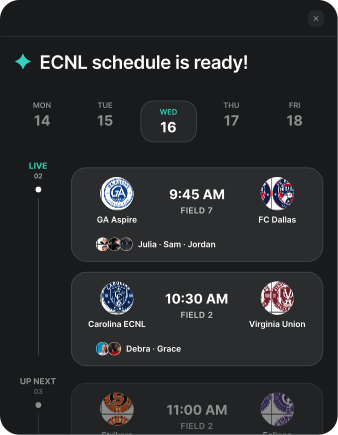

Shareable Schedule
So coaches know exactly where they need to be
Design decision · Capture
Save what matters in the moment
Coaches make observations while watching players live, often with little time to stop and document what they see. We designed Kit to move with them, making it easy to capture key moments without pulling attention away from the field.
Capture on the field
Capture on WatchContinue on Mobile
Quickly log key moments from a watch or phone without pulling attention away from the game.
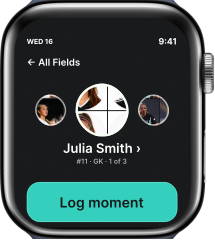
Smart Watch View
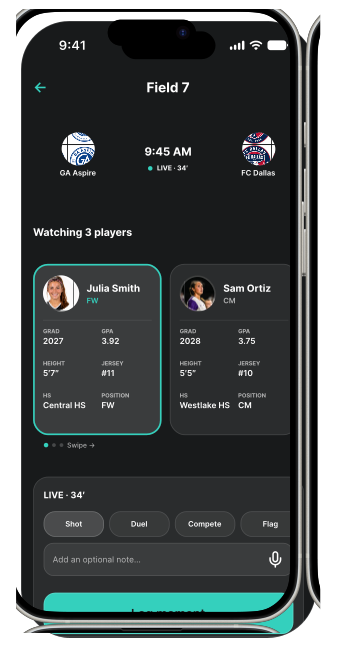
Mobile View
Log moments on the field
Stay oriented throughout the day
Keep key players in view
Log observations in the moment
- Log moments on the field
- Stay oriented throughout the day
- Keep key players in view
- Log observations in the moment
Preserve and share context
Player Video Highlight ClipsShare with Staff
Connect observations to players and share them with staff so important context isn’t lost afterward.
Design decision · Decide
Make tradeoffs visible
Recruiting decisions aren’t made in isolation. We designed Kit to help coaching staffs compare prospects in the context of their roster, making tradeoffs easier to see and discuss together.
See the bigger picture
Player ProfileShortlistDepth Chart FitUpdate Roster
Evaluate prospects alongside roster needs, position gaps, and other constraints.
Compare what matters
Roster ViewTrade Off BoardSee Kit’s Recommendations
Surface meaningful differences between players so staff can weigh tradeoffs together.
Final Offer
Less time managing recruiting, more time coaching
Designed to be agentic around the work, not the decision, Kit gathers context, synthesizes information, surfaces recommendations, and suggests next steps. Coaches make the final call.
Testing & Iteration
Testing the assumptions behind Kit
We tested early concepts with coaches throughout the design process. Their feedback pushed us to simplify the experience and rethink how AI should fit into their existing workflows.
Explore iterations
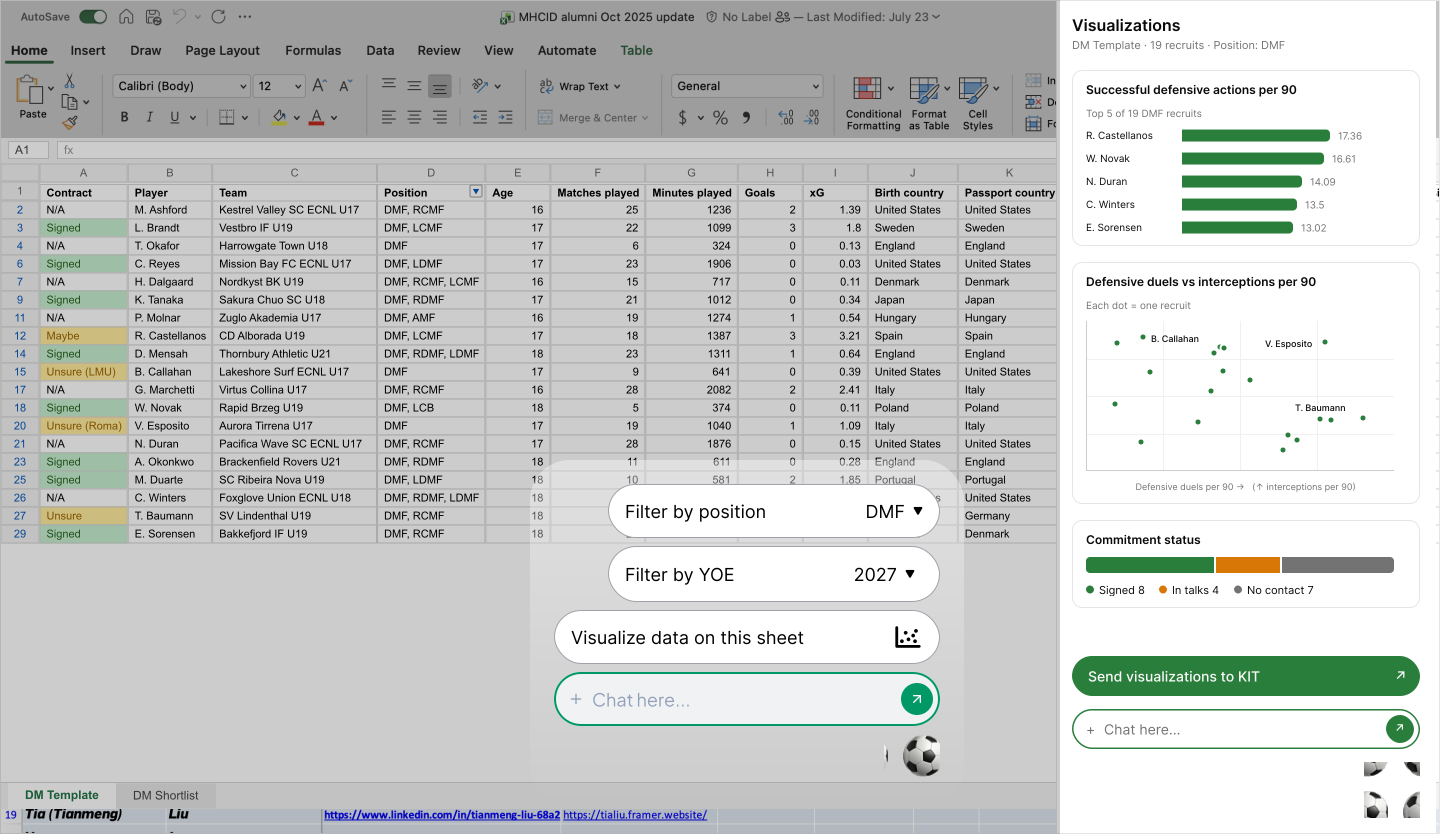
What we tried
A conventional chatbot for interacting with Kit.
What we learned
Agentic interactions needed to be intentional, not added for their own sake.
What we changed
We became more deliberate about when Kit should act proactively and when coaches should remain in control.
User Feedback
Coaches saw value in meeting them where they already work
What an incredible final product you've designed! Truly impressive and a testament to your research, creativity, and hard work. I'd love to use an AI service like this help me prep for 'ECNL Phoenix.'
Being able to manipulate a spreadsheet like that is exactly what coaches want and need.
Reflections
Designing for AI meant deciding where agency belongs
Kit began as an exploration of a messy recruiting workflow and grew into a cross-platform AI system spanning desktop, mobile, and watch. The project reinforced that designing with AI isn’t just about what a system can do, but deciding what it should do, when it should take initiative, and where people should remain in control.
Designing for AI
I learned to think beyond chat as the default AI interaction, exploring how context-aware and agentic experiences could support coaches throughout an existing workflow.
Leading through ambiguity
I drove research, stakeholder communication, and key product decisions while helping the team turn a broad, complex problem space into a focused product direction.
Protecting human judgment
We designed Kit to take on more of the work surrounding recruiting decisions without automating the decisions themselves. The coaching staff always makes the final call.
Room to grow
As a prototype, Kit would need further testing across coaching staffs, recruiting contexts, and competitive levels before measuring long-term impact.